Sunday, December 14, 2025

Gotta Dance: The Rockettes and "The Madcracker"

The Radio City Music Hall Rockettes — those high-kicking, precision-dancing marvels — are celebrating the 100th anniversary of the troupe, said to be the longest-running precision dance company in the U.S. A great interview aired on NBC News recently, with show footage and interviews with charming Rockettes past and present. 

Alas, the NBC segment didn’t mention where the Rockettes started — in my hometown of St. Louis, Missouri, in 1925. Then known as the Missouri Rockets, the 16-member troupe performed at the Missouri Theatre in midtown, with choreography by Russell Markert.  

In 1932, along with theater owner Samuel “Roxy” Rothafel, Markert took the Rockets to New York City, where they first danced as the Roxyettes. They settled in at Radio City Music Hall, changed their name and have been known as the Rockettes ever since. (Read more here.) 

The big Christmas show debuted in 1933. According to an article by Gillian Russo, the "Parade of the Living Soldiers" and "The Living Nativity" numbers have remained unchanged since then. Today, between 80 and 84 dancers are members of the Rockettes, and 36 perform at one time, with two rotating casts. 

More Fun Facts About The Rockettes 

Among Russo’s other fun facts are these:

The Rockettes do their own hair and makeup. 

The Rockettes and the singers go through 1,100 costumes for the Christmas show, which adds up to 350 loads of laundry a week. 

The Rockettes typically do more than 160 high kicks per show, but Russo noted the dancers are capable of up to 650 per day. (Ouch! And you thought your job was hard.) 

Wikipedia reports this about the genesis of the troupe: “The Rockettes were originally inspired by the Tiller Girls, a precision dance company of the United Kingdom established by John Tiller in the 1890s. Tiller sent the first troupe of Tiller Girls to perform in the United States in 1900, and eventually there were three lines of them working on Broadway.

“In 1922, choreographer Russell Markert saw one of these troupes, known as the Tiller Rockets, perform in the Ziegfeld Follies and was inspired to create his own version with American dancers. As Markert would later recall, "If I ever got a chance to get a group of American girls who would be taller and have longer legs and could do really complicated tap routines and eye-high kicks, they'd really knock your socks off."

That they did. In 2007, in tribute to their beginnings, the Rockettes were honored with a plaque on the St. Louis Walk of Fame

Why Do I Care About The Rockettes? 

Two reasons: One of the early Rockets was named Eileen Corrigan! Even if we have a remote genealogical link, I am short and round, and was not gifted with the long legs required to be a Rockette. (Good on ya, Eileen!)  

Secondly, this year marks the 40th anniversary of “The Madcracker” — said to be the first parody of “The Nutcracker” in the U.S. — and for eight years I tap danced in the show with MADCO, a regional modern dance company that toured in the Midwest and parts of Texas. I got this gig as a side hustle to my job as a newspaper reporter at the St. Louis Post-Dispatch because Ross Winter, the company’s artistic director, was a dear friend. 

Every Sunday, when Ross came over for dinner and after we took a stab at the New York Times crossword, he would plot out what “The Madcracker” would look like. He considered the show his “F*ck You, 50” gesture, and dubbed it "a pungently witty"parody of the “tired old chestnut” that almost every dance company everywhere produces every holiday season. 

As a kid, I took dance lessons, and as an adult, I was (and remain) a fan of rhythm tap, so every week after dinner I would suggest that Ross include a tap number in Act 2. One Sunday, he said, “Put up or shut up — you do the tap number.” 

I immediately hired a third-generation member of the famous Four Step Brothers — they have a star on the Hollywood Walk of Fame — to help me start dancing again. I explained to him that I can’t dance in an ensemble because I can’t count, and the young man was fine with that. “You’ve got good feet,” he said, one of the loveliest compliments of my life. Later, I worked with Webster University dance instructor Gary Hubler, who also was kind and patient.

(Full disclosure: When not being asked to follow choreography, I do (or used to do) quite well on a dance floor. Watching me in the disco on a Caribbean cruise one evening, the DJ called out, “You dance like a flamingo in heat!” Then he asked me to help him judge the dance contest later in the evening. Also, during a cruise on the Nile, I won a belly-dancing contest, possibly because I had a core and a belly to call on, unlike the skinny French women who also took part.)   

So, rocking a red sequined costume, for two weeks every year from 1985 through 1993, I tap danced in “The Madcracker.” Well, sort of. Once, when I ran off stage after my big number, Ross hugged me and said, “You actually danced to the music this time!” (Another treasured compliment.) To this day, I cherish my time spent with Real Dancers and remain in touch with some of them.

Happy 40th anniversary to “The Madcracker” and Happy 100th anniversary to the Radio City Music Hall Rockettes — dance on, one and all!        


Monday, November 24, 2025

Thankful for Thanksgiving Silliness

Anyone for Turkey Bowling? How about wacky Thanksgiving headgear? Turkey craft projects?

I really like Thanksgiving, maybe more than any other holiday, and I like a side of silliness with the traditional meal. Fortunately, my extended family goes along with that, and often contributes their own expressions of whimsy.

Last year, I bought Thanksgiving eyeglasses for everyone. Here I am, modeling the pair I chose. 

One year, I showed up with a Turkey Bowling game, tall plastic "pins" in the shape of turkey legs and balls with appalled turkey faces. We "bowled" in the long hallway, scattering turkey legs everywhere. At the end of the evening, the younger set hid a leg or two in the house for someone to find later.

Another year, I showed up with Thanksgiving Rubber Duckies, little rubber bath toys dressed in Pilgrim garb, Native American headdresses and turkey feathers. As I recall, one year I provided a herd of toy wind-up moose, and the family held moose races at the table. (Still mourning the closure of a favorite toy store: The Last Wound-up, in New York City.)  

Hats and bonnets for everyone at the table — like those Puritan men and women wore — were a big hit one Thanksgiving, provided by other family members. A few years earlier, we all donned more elaborate seasonal headgear. Here, appropriately attired, Grandma Sue whips the cream that will top the pumpkin pie and her special tasty gingerbread cake with candied ginger, served after the main meal. 

I don't do crafts — I even have a button trumpeting that message — and before you criticize me, know that I don't do crafts because I'm terrible at them. Blame a lack of manual dexterity (except when I type) or poor spatial relationships or art appreciation skills of a different sort or whatever you like, but I don't do crafts.

However, one year, I arrived at Thanksgiving with a prepackaged turkey craft project for any interested guests, and the kids were all over it. Some of the turkeys ended up serving as ornaments for the Christmas tree, an unusual after-story for Thanksgiving leftovers.

Speaking of leftovers, because everyone at our Thanksgiving dinners brings more than we can eat, we always have plenty of food to divvy up and tote home so each of us can enjoy the meal all over again the following day. Here's a sample plate from one recent year's feast. 

What I just wrote is not entirely true. In addition to pumpkin pie and gingerbread cake, my daughter-in-law's delicious apple pie is one of our cherished Thanksgiving traditions. Sadly, rarely is any left in the pie plate when the evening draws to a close. This photo shows a somewhat deconstructed piece on my dessert plate — maybe I was served first, always the hardest piece to extract from a pie.

This year, I'm not taking silly Thanksgiving-themed souvenirs or a crazy game to our gathering. Instead, I'm honoring our penchant for apple pie by sharing a fascinating factoid I learned while watching "CBS Sunday Morning." Allegedly, the first written recipe for apple pie dates back to the 14th century, and was penned for a royal cookbook by none other than Geoffrey Chaucer. How cool is that? 

Happy Thanksgiving!    


Monday, November 3, 2025

Correcting 'Alternative Facts' about Joseph Pilates' Life

Caution: If you read “Do You Speak Pilates?,” the blog I posted here on April 6 earlier this year, you need to know I repeated some information about Joseph Pilates that I have since learned is not entirely true. Today, I’ll try to correct that. 

Before I do, consider what Josephine Baker reportedly once said when asked her age. One of my favorite people (for numerous reasons), she named a highly unlikely number and then added, “not counting summers.” That’s proof that even a primary source is not always reliable — and in these troubled times, we know all about that.  

Anyway, here's some of what I've learned about Joseph Pilates. In “Bodies by Joe,” Alma Guillermoprieto’s amazing article published Aug. 21 in the New York Review of Books, she called him “a compulsive self-mythologizer,” saying "apparently Joseph Pilates did not always tell the whole truth.” (Thanks are due here to John, my Pilates instructor, for alerting me about the article.) 

For entirely different reasons, Guillermoprieto added, ”Pilates died in 1967, and I am grateful to have missed the opportunity to train with the master.” By all accounts, the master was something of a task master, though his concern for the health, muscle tone and flexability of his students apparently was genuine.   

In her article, Guillermoprieto listed three sources for readers who wanted to know more: “Caged Lion: Joseph Pilates and His Legacy” by John Howard Steel, “Hubertus Joseph Pilates” by Javier PĂ©rez Pont and Esperanza Aparicio Romero” and “Love All Around: The Romana Kryzanowska Biography” by Cathy Strack and Carol J. Craig. 

Steel’s book appealed to me the most and it was the easiest to get, so I ordered “Caged Lion” with confidence, because Guillermoprieto described the author as “a devoted pupil who wrote a fair-minded and helpful book.” 

Now a retired lawyer, decades ago Steel trained in New York City with Pilates and he also became friends with the gifted but eccentric man who developed the exercise program that he called “Contrology.” Now better known as “Pilates,” the low-impact regimen currently is practiced by more than 15 million people in the U.S., according to CNN, and Pilates has been dubbed “the fastest-growing fitness trend.” Statista reports that in 2024, “nearly a million people participated in Pilates training in the U.S.” Yowsa! 

Unaccustomed as I am to being part of any trend since my hula hoop days, I’m a Pilates convert, as I explained in that earlier post. In his book, Steel writes about his own early days on the reformer in the tiny studio, but he also writes about his relationship with Clara Pilates, who died in 1977, a decade after Joseph's passing.  While serving as Clara’s lawyer, Steel discovered that the couple had no paper trail — no licenses, leases or bank accounts — and they ran the studio as a cash-and-carry operation. 

Over the years, Steel and other devoted Pilates practitioners rescued the business from extinction twice, and as he tells it, the story features numerous twists, turns and lessons in diplomacy. Though he never abandons his tone of respect for Joseph Pilates and his significant accomplishments, at the end of the book, Steel does refute a lot of the conventional wisdom (it's everywhere) about Joseph’s personal history. 

Was he a boxer? A circus performer? A prisoner of war? Did he leave behind two wives and a couple of children before heading to America on a ship? Did he marry Clara? Did he ever acknowledge her contributions to Contrology? If you are at all tantalized, read “Caged Lion.”    

As a writer who likes when readers contact me with kind words about my work, I sent Steel a note. I thanked him for writing the book, and also said I appreciated his connecting Mihaly Csikszentmihalyi's flow theory with the mindfulness element that is key in Pilates classes. (Full disclosure: I was privileged to edit my  friend Linda’s doctoral thesis on Csikszentmihalyi’s theory as it applies to mathematics classes in elementary schools, so I know about his theory of "flow" and can even pronounce “Csikszentmihalyi” correctly. Try me.)    

Steel wrote back: “I loved your blog and thanks so much for your kind words. I still think “Flow” explains so much, even though not fully appreciated by many teachers or students. I was fortunate to find Mihaly’s book when trying to understand my deep attraction” to Pilates exercises. Steel said he also enjoyed what I wrote about Fred Pilates, who lived and taught in St. Louis. (For details, see my earlier blog post.) 

Steel continued, “I never met him and, typically, Joe never once mentioned him. But I suspect the machining that went into the reformer started with Fred, not Mr. DeSafio. Fred’s family was very upset with me after Clara died and the apartment had been stripped bare of memorabilia (and perhaps money). I was in California in a long trial when Clara died and the judge wouldn’t allow me to go back.” We'll never know what was lost.

Over the last two months, assorted sprained/strained muscles and/or a pinched nerve — complemented by a ridiculous gash on my hand — have kept me away from Pilates classes, but I’m easing back in and glad of it. Back on the reformer last week, I was pleased that my body remembered we’d been here and done that before, so I can confidently report that I still speak Pilates.

And now, I can speak more accurately about the man behind the method. 


Monday, October 13, 2025

Of Hats, Flowers, French Fries, Friends, Trees and Party Lights


Yes! 

Blog posts have lagged lately, because sometimes, writers have to pay more attention to living than to writing about their lives, and that's my excuse. Part of the interruption has been due to joyful visits from faraway friends, part from lots of work assignments (yay — interviews with Tim Curry and Baayork Lee!) and part from pesky health issues that demanded attention but finally are fading. (I'm fine.) 

Here's the story about that marvelous hat pictured above.

Playwright, teacher and friend Mariah Richardson popped in for a visit from St. Louis one day in June, and in discussions about either aging or politics (both are fraught), I mentioned that artist and activist Mary Engelbreit had devised a hat with a perfect full sentence on it — "No." — and I was trying to decide whether to buy the white one or the black one. 

After we gabbed for hours and she left, Mariah made the decision for me, and 10 days later the perfect hat arrived. I was so excited that I immediately ordered one for a friend. 

I've also been busy gardening on my 13th floor balcony. Decades ago, my friend Gail dubbed me the Accidental Microwaver (with apologies to Anne Tyler) because I was befuddled about how to use the one in the newspaper's lunchroom. I got good at that, but as recorded in earlier blogs here, I am an Accidental Gardener. I doubt everything I do when it comes to raising geraniums (aphids got them), succulents (high winds and days of rain did them in) and my ginkgo tree, which dutifully leafs out every year about a month after I declare it dead. 

Two years ago, I dropped some California poppy seeds into the ginkgo's large pot, and had poppies galore. (See above.) This spring, I decided to buy some soil, buy some seeds and grow more poppies in my beautiful blue pot. I followed the directions exactly as written on the seed package. Here's how it went this time:

And that was that. No actual poppy flowers ever emerged. Sigh. Maybe next year. 

Speaking of greenery, San Francisco restaurants have a plethora of amazing salads on their menus, and sometimes I opt for a fancy salad instead of a sandwich or even pizza. As I eat in more often than not, DoorDash kindly brings me what I'm in the mood for, and a delivery order from a Greek restaurant I'd not previously tried offered a surprise: French fries mixed in with the greens, other vegetables and chicken that I most often prefer. 

The salad was lots of fun, but as we all know, French fries are best when devoured immediately, when they are hot and crispy. I had to toss some of them. Still, not sorry. It's important to Try New Things, right? 

In Other News, as they say on television, I attended a memorial picnic with family and friends to honor the passing of a woman who welcomed me with open arms when I moved to San Francisco 15 years ago. 

A longtime friend of my daughter-in-law's mother, Denise was fun and feisty and very hard to book a lunch date with, as so often she was either out and about with her beloved grandkids, cooking family dinners, holding school reunions on her fabulous two-story deck at her home, off on a mission of mercy visiting friends who were housebound or standing in line at the post office to mail books or seasonal chocolates to other friends in need. 

Still, we did make time for lots of lunches and we also spent hours and hours binge-watching favorite shows and keeping up with the latest gossip abut the actors. The picnic was held at California's magnificent Samuel P. Taylor State Park. At one point, sitting peacefully by the creek, thinking about how much I miss Denise and staring up through the redwood branches, I took this picture:


This time of year, as the light fades earlier and earlier, I've been thinking of ways to "lighten up." That doesn't mean I will stop calling Congressional reps to voice my opinion (you can do it, too) on the issues of the day or that I will put away my "No." hat or stop arguing politics with people who share all my beliefs about the trouble this country is in, but to balance all that, I'm looking for good books and movies to lift my spirits. 

For example, smack in the middle of reading "Lin-Manuel Miranda: The Education of an Artist," a biography about this charismatic genius by Daniel Pollack-Pelzner, I put down the book and watched the movie version of the ebullient "In the Heights." 

Since seeing the latest (and allegedly last) Downton Abbey movie, I've started dropping in on the Crawleys way back in Season One, and that's fun! (I would have lost the bet had I been asked to guess how early Poor Mr. Pamuk made his brief appearance.) I've also caught up on "The Gilded Age," and loved the comment in Season 3 about all those rich people in New York City parading around as though they were at court in France. 

I'm also upping my theater game, and already bought a ticket for a stage production of "Hamnet," coming here next spring. Yes, I'll see the movie too, as I loved Maggie O'Farrell's book. And later this week, I'll see a local production at SF Playhouse of "Noises Off," the only farce I've ever thoroughly enjoyed.  

Also, with a lot of help from my family, the latest version of party lights on the balcony has been installed. Every evening, I am amazed at just how festive they make me feel.  

Here's to light in your life!    


Sunday, June 15, 2025

Celebrating 15 Years in San Francisco

On Sir Paul McCartney’s 83rd birthday (June 18), I will raise a glass to him and also celebrate that I moved to San Francisco that very day 15 years ago! (Celebrating will be easy; I’ll be out to lunch with my friend Denise, kicking off what our mutual friend calls “The Birthday Season.”) 

After donating, selling and otherwise discarding two-thirds of my possessions, I vacated my 1,700-square foot condo in St. Louis County and moved halfway across the country to be with family, who warmly welcomed me and my 16-year-old cat.  

The next day, I found a splendid 725-square-foot apartment with a view of the Golden Gate Strait, and settled there for a comfortable decade. Five years ago in July, I moved into a "junior one-bedroom" unit on the top floor of an independent living building (with TWO splendid elevators!), which I call the Senior Dorm. 

In Puccini's “La Boheme,” Mimi sings this to Rodolfo: “I live alone in a small white room, and I look out over the roofs and into the sky.” Me too — but I also have a view of the south tower of the Golden Gate Bridge, which reminds me that I live on the edge of the continent — exactly where I belong.

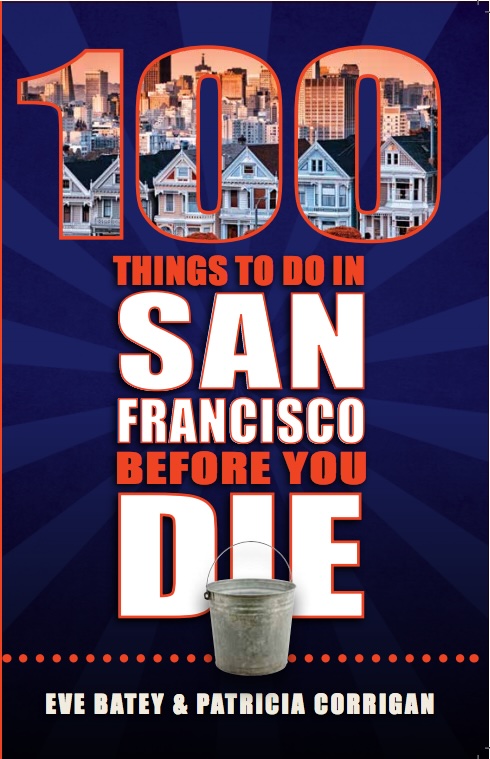
Four years after I got to town, I was asked to write a guidebook to San Francisco. I went in search of a writer who had been here longer, someone with more street cred than I had accrued, and Eve Batey and I then wrote about at least 250 things (expanding on the publisher's title) to do in this marvelous city. In this post, I’m displaying some of the photos I took for that book, which is out of print.


Working on the book taught me much about my new home, because I spent hours exploring — hopping on and off buses, driving to unexplored neighborhoods and interviewing natives. That’s why I now can recommend bakeries, bookstores, shops, restaurants, theaters, groceries and historical attractions in many a neighborhood. I also know several places to sit and look at great bodies of water, one of my longtime hobbies. 

Another St. Louis native lives in my big apartment building, and a former neighbor also knew that city well, but most often, I’d rather talk about today, not yesterday. And though it’s always tempting to look into the future, someone told me long ago there is no broom large enough to sweep up debris accumulating in the years ahead, so why bother trying?

Do I miss my old stomping grounds? No. Of course I miss some of my dear friends there (and the best damn soaking tub ever), but after living in one place for six decades (I don't count the year I maintained an address just outside an army base in Oklahoma) and writing countless articles for the St. Louis Post-Dispatch for over two decades, I knew I had been everywhere, interviewed everyone and done everything I needed to do there. I was ready for an adventure! 

Today, living with 130 people from many cities and countries in a 13-story building does bring with it some drama. Sometimes, I participate (venting at residents’ meetings or even gossiping in the lobby) but most of the time, I try to step back, see the big picture, and remind myself that what’s going on the world, this country, this state and my adopted city is more important. Sometimes, I shut out all of it and concentrate on what’s good in my life. 

I’m old enough to know that everything changes; it’s inevitable. And I’ve learned that initiating a big change is empowering, brings a jolt of fresh energy, allows you to see with fresh eyes, even if you aren’t sure how to get home from the grocery those first weeks after a big move. It’s a lot of work, a lot of teensy, annoying details and a lot of rethinking, required when you no longer can say, “But I’ve ALWAYS done it this way!”

Looking back, I realize that may be the best part of reinventing yourself somewhere new. (Two former co-workers who also followed their grown children to new cities and an old friend who just moved back to her hometown can speak to the rewards, in case you are in need of encouragement.) 


That’s how it feels today, as I process that somehow, 15 years in San Francisco have zipped by!  


Sunday, May 25, 2025

Am I Losing My Fastball?

 Everything started out great — I got in a short line of other kids outside Oracle Park to have my picture taken with Chewbacca before heading to the seats with the family for the Giants game on Star Wars Day. 

I bought a bottle of cold water because our seats were in the sun and it was warm for San Francisco, with no significant wind. I took one big drink and then got distracted by the game — and a Ghirardelli hot fudge sundae. As the first half of the 7th ended, I felt weird — dizzy and disoriented. I left the family, climbed up lots of stairs and lurched into the air-conditioned Club Level. 

Leaning against a wall near a crowded food stand, I spied a single available chair at a small table occupied by a middle-aged woman. When I asked her if I could sit there, she said yes. Gratefully, I removed my hat and took slow, deep breaths in the cold air. Soon after, the woman left the table, leaving behind a glass of lemonade on ice, about a third full. Still woozy, I grabbed the glass, removed the lid and straw and slurped up the liquid.

Surprise — the woman came back to the table! 

I apologized and told her I’d thought I might faint, so I had gulped down the last of her drink. “I’m not the fainting kind,” I said, "but I was worried." She said she often passes out, so she understood. Then she left the table again, to buy me a bottle of water at the food stand. She sat with me while I drank it, and she refused to take any money for her kindness. (I will pay this forward, somehow.) 

When the family found me, I was feeling much better, but opted not to go back outside. I watched the rest of the game on a big monitor near my chair. Later that evening, I realized this was the third time I’d done something stupid in the last six months. 

Late last year, as I got out of an Uber one evening, I grabbed my tote bag but left my purse behind, something I realized once I was in the lobby of my apartment. I’d had my keys in my pocket, so I was able to get in, get to my computer and alert Uber. The driver came back with my purse within 30 minutes. (I tipped her lavishly.) 

A month ago, in one of my decluttering modes, I donated four old eyeglass cases — and one of them contained the prescription glasses I wear at the pool when I exercise. They’re gone for good, as I didn’t realize my mistake until two weeks later. 

I have blamed these mistakes on aging. I know older adults can get dehydrated quickly — heck, I've written about that. I know to check the seat before getting out of an Uber. I know I should have opened the eyeglass cases before sending them to Goodwill. 

Whining about my senescence has been helpful; even encouraging, because friends keep telling me these kinds of mistakes are common, and not just among older people. Two friends, both my age, were startled to hear I went to a day game, as they gave that up long ago because of the hot sun. One has quit going to baseball games entirely, because of all the walking and climbing required.  

Three friends pointed out that if people didn’t leave things in Ubers all the time, the website wouldn’t make it so easy to report what you left behind. And one accused me of being too hard on myself and then asked if I were a perfectionist, trying to make other people look bad.  

In my current Calm Down Mode, I remembered that in a recent interview with 80-year-old writer Jane Seskin, she shared with me her sensible approach to aging:

  • Acknowledgment
  • Accommodation
  • Acceptance

Wise words, which I will keep in mind next time (of course there will be a next time) I do something stupid. I just hope I’m not losing my fastball.  


Sunday, April 6, 2025

Do You Speak Pilates?

Contrology. Table top. Candlestick. These are words I say to myself when moving through the world, when engaging my core so I can lift both legs to a 90-degree angle and when stretching one or both legs straight up, toes pointed at the ceiling. I also intone, “Sit with intention” every time I correct my sloppy posture.

In other words, I speak Pilates.

Just over a year ago, I enrolled in Pilates Reformer classes at my fitness center. The very idea seemed intimidating at first, but friends who had taken the classes all insisted that Pilates — taught on the machines, not on a mat — got them in great shape, alleviated back or shoulder pain for some and got them moving better. 

Still, at first I thought I may be too old, or maybe it would make my three kinds of arthritis, my scoliosis and my stenosis worse. Informative websites refuted all that, saying Pilates could help. The same websites promised increased relaxation and a reduction in cortisol, the stress hormone. (Some of us have so much of that right now — maybe we could set up a kiosk at the mall and sell the excess?)  

Like yoga, Pilates also demands that the mind and body work together. Low-impact Pilates Reformer classes also can improve core strength, increase flexibility and help with posture, balance and gait. The springs and straps on the Reformer machine — which resembles a low massage table but has a moveable carriage — and assorted pieces of equipment provide a full-body workout, said to be suitable for all fitness levels. 

That said, I had to fill out a “training intake” form for the gym before enrolling. I figured I would be rejected, as my musculo-skeletal issues hinder my mobility, and just recently my body reminded me that I need to refrain from moving furniture. (Ouch.) Surprise — I was accepted, and was invited to try Pilates. 

I’m no jock, but I’ve been doing water aerobics and yoga for almost 50 years, taken classes in Zumba, Qi Gong, Jazzercise and Tai Chi, lifted free weights and worked out on assorted machines at various gyms. Out of necessity, I’ve also had to learn physical therapy exercises for several body parts. (Sigh.)  

Perhaps due to a childhood filled with dance and gymnastics lessons and the many hours I spent playing circus and pirate ship with friends on my backyard swing set, I’m also limber and I have strong thighs. (Sometimes, my cousins and I are grateful for our burly "Corrigan Thighs" and sometimes, we wish they were smaller.) A few years ago, after a yoga teacher instructed the class to do legs-up-the-wall, she moved around the room to help her  students. When she got to me, she said, “You have marvelous hamstrings!” I replied that I used to be a can-can dancer, which is a lie.  

After I took three private Pilates Reformer classes at the gym, I signed up for group lessons. I’ve opted to stay in the Pilates Reformer Foundations class, and still have no interest in moving to the next level, as I do not want to stand on the Reformer. Ever. Some days, I confidently stride into the studio and show off my impressive leg circles, with or without straps for support. Other days, I wobble in, crunchy and stiff, and barely make it through the 50-minute class. Either way, I walk out feeling taller and stronger. Pilates works for me.   

The Founder of the Pilates System 

Joseph Pilates (1883-1967), a German-born gymnast, boxer and circus performer, developed the exercise program — he dubbed it “Contrology” — while held captive as an enemy alien in Lancaster, England, during World War I. He incorporated elements of gymnastics, yoga, dance and martial arts (and allegedly even the stretching techniques he had observed in cats), and he patented 26 fitness devices in his lifetime. Here's an interesting blog post from a Pilates instructor. 

Fun Fact: Pilates spent time in a second internment camp on the tiny Isle of Man in the Irish Sea, and classes still are taught there. Here is a Facebook page based there. 

After the war, he returned to Germany. Around 1925, Pilates immigrated to the U.S. On the ship, he met Clara Zeuner, a nurse, and they later married. In New York City, the couple founded the Joseph H. Pilates Universal Gymnasium, where Clara helped refine the exercises and they taught for almost 40 years. 

Several sources claim their students included dancers Ruth St. Denis, Ted Shawn, George Balanchine, Martha Graham, Jerome Robbins and Suzanne Farrell as well as violinist Yehudi Menuhin, opera singer Roberta Peters and actor Lauren Bacall.  

You can learn more from Pilates’ book “Return to Life through Contrology and Your Health” or from the updated version, “Pilates Evolution — The 21st Century” by Joseph Pilates, Judd Robbins and Lin Van Heuit-Robbins. Also, a documentary, “A Movement of Movement,” was released in 2013. 

Pilates as Practiced in the Mississippi River 

Joseph Pilates had a brother — Clemens Fred Pilates — who went by Fred. (1890-1978) A machinist/tool and die maker whose leg was injured in World War I, Fred not only embraced his brother’s devotion to Contrology, but is said to have built the early claw-footed Reformer. In 1953, he opened the first recorded Pilates home studio in St. Louis, Missouri — in his own house. He taught classes there and in some local gyms, and also spent time in public parks, encouraging older adults to exercise more. 

Among his many inventions designed to boost fitness were an “air cycle,” which Fred crafted from bicycle parts mounted on two surf boards. The user propelled the machine through water by pedaling, which strengthens the legs. The St. Louis Post-Dispatch published a feature article on Fred in January 1968, following up on an earlier story in the Star-Times newspaper that ran an amazing photo of Fred using the device in the Mississippi River — the largest working river in the country. 

My Pilates instructor gets credit for telling me about Fred's St. Louis connection and sending me the clips about him. (Thanks!) Just today, I wondered if either Pilates brother had any offspring. Joseph did not, but one article I read mentioned three of Fred’s daughters: Gertrude Pilates, Mary Pilates LeRiche and Frances Pilates Battles.  

As an adult, Mary, born in 1920, taught classes in her uncle’s studio in New York City for a time and then returned to St. Louis to help her father teach and develop additional fitness equipment. The last mention I found online about her indicated that Mary moved to south Florida, where she taught Pilates for decades. I found no obituary for her, so she is 89 now. 

In 2022, the Pilates by the Bay studio in Toms River, New Jersey, posted some wonderful historic pictures of Clara and Mary. Also, I read that in 2020, when Mary accepted a speaking engagement in Jupiter, Florida, she arrived with a box, about 12 inches long and 5 inches wide, that held a miniature replica of the Reformer that her father had made for her. Pilates instructor Bonnie Hubscher reported, “It was complete with leather straps, a moving carriage on tiny wheels, and tiny springs from watches.” 

Attention must be paid while on a Pilates Reformer, but should my mind wonder at all, I have so much to think about!